

The Red Thread: On Marking Clothes as Ours
Intimacy, ownership and the clothes we choose to keep. From French wash houses to our first brand event.

Two summers ago, I got married just outside Isle-sur-la-Sorgue.
A truly dreamy Provençal town with pastel-hued alleys, a glorious food market, and a cold stream circling the centre where you can dip your toes, melting gelato in hand. And most importantly: the best antique shopping in Europe.
Vintage white French linens are everywhere. Small shops are stacked floor to ceiling with nightgowns, shirts and sheets, many monogrammed with delicate cursive initials.
A few days before our wedding, I found a lace-strapped linen nightgown embroidered with “MR” over the heart.
Close enough!
My stepmum added a red stitched S, and I wore it while I got ready to marry my best friend.
Perhaps incredibly corny. But I’m a real sucker for a sentimental detail — and that dress has become one of my favourite pieces in my wardrobe. Not because I wear it most often, or because it’s especially flattering (it’s not). But because it’s marked in a way that makes it feel perfectly mine.


For centuries in France, linen was embroidered for practical reasons. Laundry was done communally at village wash houses, where dozens of near-identical white garments were scrubbed side by side. If you didn’t stitch your initials into the hem, it might not find its way home. Red thread was commonly used because the pigment held up to boiling water and harsh soap.
A small symbol of belonging that lives on past the item’s original owner.
I recently sourced a collection of authentic French laundry labels from a wonderful collector in the Netherlands named Lennekke. She told me her father had similar initials sewn into his army laundry bag at eighteen — a bag she still keeps, and says she will pass to her children one day.
We both seem drawn to the same thing: the intimacy of marking fabric as “ours”. Stitching a letter into cloth shifts something, a garment stops being generic and becomes claimed. Suddenly, it’s worthwhile of care and stewardship. It feels like a ritual of clothing domestication, an idea that the creator DRAFT talks about beautifully on TikTok.
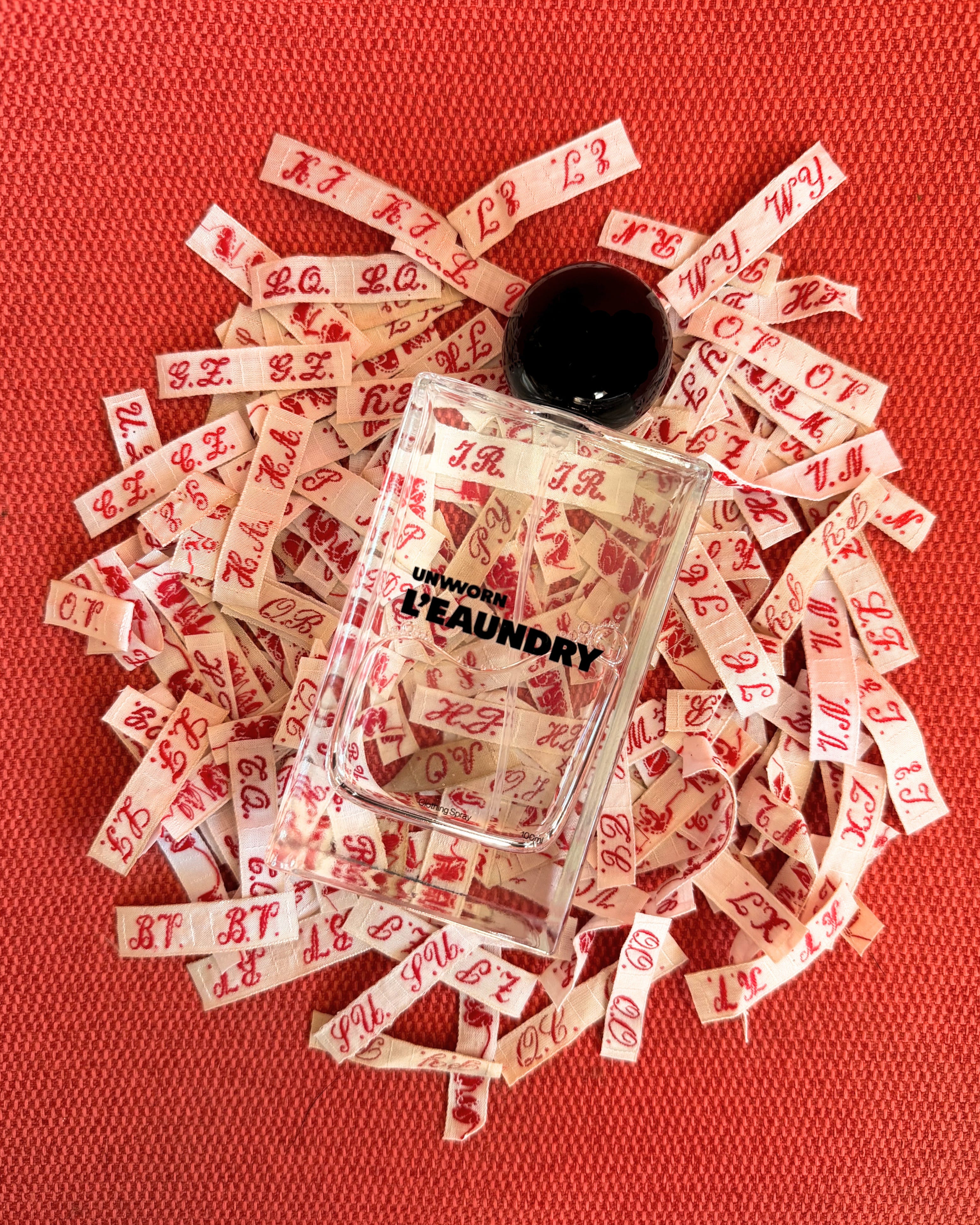
Fashion today moves fast, physically and emotionally. We buy quickly, discard quickly. The emotional lifespan of clothing has shortened. But I sense (and hope) a pendulum swing back towards something more lasting and meaningful.
Last week, I hosted my first UNWWORN event with Ray at Swayed Studio and Lissy Clow. We asked a small group of London editors and creatives to each bring one garment they hope to still love in fifteen years. Each piece was given a hand-sewn linen cover to personalise with red thread. As they embroidered, each item was styled and photographed as the first entries into Archive 2040: a project I’ve been working on that explores how we care for and hold onto the clothes we love.
It was such a warm evening. Everyone shared stories about what they’d brought — pieces passed down from grandparents, a thrifted jacket that survived a fire, dresses splurged on in high school and reworn for years.
I was overwhelmingly happy everyone leaned in. That they matched my slightly unhinged level of sentimentality with minimal hesitation. There’s something really special about watching someone talk about a piece of clothing like it’s a person they’ve known for years. And it made me want more of it. More spaces where we talk about what we keep, not just what we buy.


I’d love to host another evening like this. So if it’s something you’d be into, drop a comment <3